PCD Pharma Franchise Company for Sachet

Nutraceutical Pharma Franchise
May 26, 2026
PCD Pharma Franchise for Dermatology Products
July 1, 2026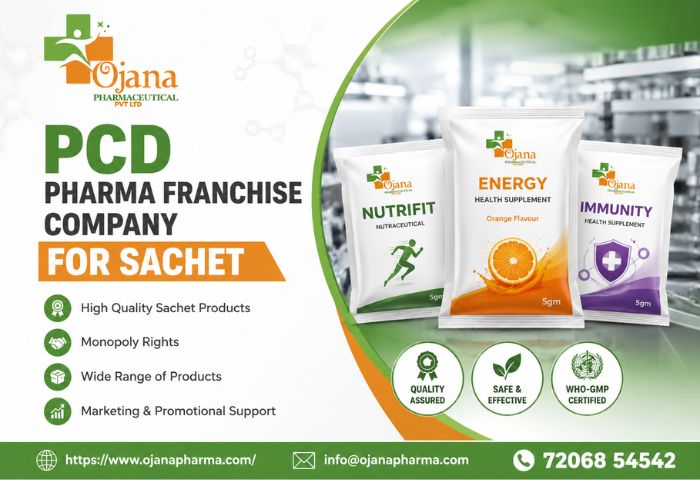
The global pharmaceutical and nutraceutical sectors are experiencing an unprecedented transition toward patient-centric, single-dose packaging formats. Among these, powder-filled sachets have emerged as a dominant and highly preferred delivery mechanism for therapeutic supplements, probiotics, and essential vitamins. For healthcare entrepreneurs, medical representatives, and distributors seeking a high-margin, low-risk business, partnering with an established pcd pharma franchise company for sachet formulations offers a direct pipeline to a rapidly expanding consumer demographic.
Unlike conventional tablets or large capsules, which can present swallowing difficulties (dysphagia) for pediatric and geriatric patients, sachet formulations dissolve instantly in liquid. This unique convenience, combined with excellent chemical stability and precise pre-measured dosing, has made sachets a primary recommendation for modern physicians. This article explores the mechanical advantages of sachet packaging, high-demand product categories, the economic benefits of investing in a pcd pharma franchise in India, and a complete roadmap to choosing the right manufacturing partner.
1. Why Sachet Packaging is Outperforming Traditional Dosages
Sachet packaging has transformed the distribution of active pharmaceutical ingredients (APIs) and dietary supplements. It is not merely an aesthetic choice; rather, it is a highly engineered solution to several clinical and logistical challenges associated with solid oral dosages.
Superior Ingredient Stability & Barrier Protection
Many active ingredients, particularly live probiotic cultures and moisture-sensitive vitamins, degrade quickly when exposed to environmental humidity, light, and oxygen. Standard multi-dose bottles or even cheap plastic blister strips allow micro-amounts of ambient air to seep through over time.
High-quality pharmaceutical sachets utilize a multi-layer composite foil laminate structure that provides complete barrier protection.
       [ Cross-Section of a Medical-Grade Sachet Barrier ]
       ┌──────────────────────────────────────────────┐
       │ Layer 1: Polyester (PET) - External Print    │
       ├──────────────────────────────────────────────┤
       │ Layer 2: Adhesive Tie Layer                  │
       ├──────────────────────────────────────────────┤
       │ Layer 3: Aluminum Foil - Zero-Permeability   │
       ├──────────────────────────────────────────────┤
       │ Layer 4: Polyethylene (PE) - Food-Grade Seal │
       └──────────────────────────────────────────────┘
This multi-layer construction ensures that volatile chemical compositions remain stable for their entire shelf life, retaining close to $100\%$ potency from the manufacturing plant to the patient’s glass.
High Patient Compliance and Precision Dosing
Overdosing or underdosing is a persistent issue with liquid syrups and bulk multi-serving powders where patients must use generic household spoons. Sachets eliminate this margin of error completely.
Each unit is pre-filled with the exact therapeutic dosage required for a single administrative cycle—whether it is a highly concentrated $60,000\text{ IU}$ dose of Vitamin D3 or a specific $3\text{ g}$ therapeutic blend of L-Arginine. Furthermore, because the powder is mixed with water immediately before consumption, it provides rapid systemic absorption compared to a compressed tablet that must first undergo mechanical disintegration in the gastrointestinal tract.
2. The Strategic Landscape of PCD Pharma Franchise in India
India’s position as a global pharmaceutical powerhouse makes it an exceptional ecosystem for franchise operations. Investing in a pcd pharma franchise in India has become a highly lucrative venture because the domestic market is maturing past generalized generic medicine toward highly targeted, value-added formulations.
The rise of the Indian middle class, paired with escalating healthcare awareness, has triggered a surge in preventive wellness. Healthcare consumers are actively seeking specialized, easy-to-use health supplements.
By operating within a monopoly-based PCD (Propaganda-cum-Distribution) model, local partners can establish deep-rooted distribution networks without facing direct competition from the parent brand within their territory. This structural protection, coupled with lower domestic manufacturing costs under WHO-GMP conditions, guarantees a resilient, long-term business model.
3. High-Demand Sachet Categories for Your Franchise Portfolio
When selecting products from your chosen pcd pharma franchise company for sachet, a diversified, clinically validated portfolio is crucial. Doctors will only prescribe formulations that are backed by scientific research and exhibit excellent palatability.
| Category | Key Compositions | Major Clinical Application |
|---|---|---|
| Probiotic & Prebiotic Blends | Saccharomyces boulardii, Lactobacillus acidophilus, Bifidobacterium longum, Fructooligosaccharides (FOS) | Gut microbiome restoration, pediatric diarrhea management, IBS therapy |
| Urinary Tract Health | Cranberry Extract ($300\text{ mg}$), D-Mannose ($600\text{ mg}$), Potassium Magnesium Citrate | Non-antibiotic UTI prevention, urinary tract lining protection |
| Cardiovascular & Pregnancy Support | L-Arginine ($3\text{ g}$), Proanthocyanidins ($75\text{ mg}$) | Preeclampsia prevention, improved uterine blood flow, nitric oxide synthesis |
| Bone & Mineral Health | Cholecalciferol (Vitamin D3 – $60,000\text{ IU}$) granules | Severe Vitamin D deficiency, osteoporosis management, joint health |
| Cosmeceutical & Anti-Aging | Hydrolyzed Marine Collagen Peptides, L-Glutathione, Vitamin C | Skin elasticity restoration, cellular hydration, anti-pigmentation |
| Pediatric Rehydration | WHO-recommended Oral Rehydration Salts (ORS), Zinc Gluconate | Acute dehydration recovery, electrolyte balance during gastroenteritis |
4. How to Evaluate a PCD Pharma Franchise Company for Sachet Products
The market is saturated with distributors, but your long-term success hinges on the raw quality of your products and the reliability of your supplier. Use these four critical evaluation criteria before signing a franchise agreement:
1. Verification of Quality Certifications
Never compromise on certifications. The manufacturing facilities of your partner company must hold valid WHO-GMP (Good Manufacturing Practices) and ISO 9001:2015 accreditations. For dietary and health supplement sachets, the manufacturing unit must be explicitly registered under the Food Safety and Standards Authority of India (FSSAI). This ensures that every batch undergoes rigorous microbiological testing to confirm the complete absence of heavy metals and pathogens.
2. Sachet Sealing and Foil Quality
Powdered supplements are highly hygroscopic (they easily absorb moisture from the air). If a company uses cheap paper-backed laminates or has poor temperature controls on their rotary vertical form-fill-seal (VFFS) machines, the powder inside the sachet will turn into a solid, unusable lump within months of storage. Inspect physical samples of their sachets:
- Ensure they use high-grade aluminum-based ALU-ALU or multi-layer plastic laminates.
- Check the seal integrity on the side and bottom edges to prevent powder leakage.
- Look for clean, legible batch coding and expiry printing that does not rub off easily.
3. Bioavailability and Taste Profile
Supplements like L-Arginine or Cranberry can naturally taste highly bitter or astringent. Pediatricians and general physicians will stop prescribing your brand if children or adult patients reject the taste. A leading pharma partner will invest in high-quality, sugar-free flavoring agents and taste-masking technologies to make the reconstituted solution highly palatable.
4. Direct Promotional Support
To build clinical trust, you must present professional materials to medical professionals. Ensure your parent company provides:
- Visually striking detailing guides and scientific literature.
- Free product samples for doctor trials.
- Custom-printed visual aids, reminder cards, and prescription pads with your franchise details.
                  ┌──────────────────────────────────────────────┐
                  │    Sachet Manufacturer Audit Checklist       │
                  ├──────────────────────────────────────────────┤
                  │ [ ] FSSAI and CDSCO Approved Compositions    │
                  │ [ ] Multi-Layer ALU/Foil Packaging Standard  │
                  │ [ ] Taste-Masked, Patient-Friendly Flavors   │
                  │ [ ] Guaranteed Territorial Monopoly Rights   │
                  │ [ ] Low Minimum Order Quantity (MOQ) Options │
                  └──────────────────────────────────────────────┘
5. Steps to Establish Your Sachet Franchise Business
Once you have identified a reliable supplier, launching your business requires a systematic approach to legal compliance and distribution setup.
Step 1: Secure Business Registrations
To distribute pharmaceutical or food products, you must comply with state and national licensing laws:
- Wholesale Drug License (DL): Mandated by the State Drug Control Authority for stocking any dual-action pharmaceutical or therapeutic formulations.
- FSSAI License / Registration: Required to store and trade nutritional sachets like collagen, probiotics, or multivitamin blends.
- GSTIN (Goods and Services Tax Number): Essential for all invoice generations and legal transactions across state borders.
Step 2: Establish Climate-Controlled Warehousing
Sachet powders, particularly probiotics, are highly sensitive to thermal degradation. If your storage warehouse exceeds $30^\circ\text{C}$, the live bacterial CFU (colony-forming units) count in your probiotic sachets will decline rapidly. Set up an insulated storage facility equipped with active air conditioning and digital temperature logs to maintain storage conditions strictly below $25^\circ\text{C}$.
Step 3: Formalize the Territorial Monopoly Agreement
Review the franchise contract carefully. Ensure that your geographical boundaries are defined precisely down to the specific zip codes or administrative districts. This ensures that no other distributor can buy the same brand from the parent company and undersell you in your local market.
6. High-Impact Marketing Strategies to Generate Demand
Simply stocking inventory is only half the battle; you must actively generate prescription traffic from local healthcare professionals.
- Target the Right Specialist Segments:
- Schedule clinical visits with gastroenterologists and pediatricians to pitch high-CFU prebiotic and probiotic sachets.
- Meet with gynecologists to highlight your L-Arginine and prenatal mineral blends.
- Target orthopedics with premium collagen peptide formulations designed for cartilage repair.
- Chemist-Level Placement: Ensure that prominent pharmacies near major medical clinics have adequate stock of your products. Pharmacists must be educated to recommend your brand when presented with open-ended wellness prescriptions.
- Organize Doctor-Patient Camps: Sponsor local health awareness camps (e.g., bone health camps or gut health screenings) and hand out single sachet samples to raise direct consumer awareness.
7. Frequently Asked Questions (FAQs)
Q1: What is the average profit margin when working with a PCD pharma franchise company for sachet products?
The profit margins in sachet products are generally higher than standard tablets or capsules due to their value-added nutritional and therapeutic compositions. Typically, franchise partners can expect net profit margins ranging from $25\%$ to $45\%$, depending on the volume of sales, geographical pricing, and operational overheads.
Q2: Is a Drug License mandatory for selling dietary supplement sachets?
If the sachet compositions are classified purely as food supplements or nutraceuticals under the FSSAI guidelines, a State or Central FSSAI license is sufficient. However, if the sachet contains therapeutic drugs, APIs, or controlled formulations (such as specific anti-bacterial or prescription formulations), a valid Wholesale Drug License (DL) is legally mandatory.
Q3: What is the typical Minimum Order Quantity (MOQ) for sachet franchises?
Most PCD franchise parent companies offer flexible initial ordering options for regional distributors. While the MOQ for customized third-party manufacturing can range from $10,000$ to $20,000$ sachets per batch, an established PCD franchise model often allows you to start with smaller, ready-to-dispatch inventory batches of as low as $1,000$ to $2,000$ sachets per composition.
Q4: Why do some probiotic sachets turn hard or lump inside the packaging?
This issue is caused by moisture ingress. Probiotics and effervescent granules are highly hygroscopic. If the pcd pharma franchise company for sachet utilizes low-grade, single-layer plastic wrapping instead of multi-layer ALU-ALU or PET/Al foil composite structures, ambient humidity will penetrate the seal. Always ensure your supplier utilizes advanced rotary VFFS machinery with hermetic heat-sealing features.
Q5: Can I secure monopoly rights for an entire state in India?
Monopoly rights are typically allocated on a district-wise basis to maximize marketing penetration. However, if you demonstrate a strong distribution network, substantial financial capacity, and commit to meeting higher monthly or quarterly sales targets, a parent company may grant regional or state-level exclusivity.
Q6: What is the standard shelf life of pharmaceutical sachets?
Generally, high-quality, foil-sealed sachets have a shelf life of $18\text{ to }24\text{ months}$ from the date of manufacturing. To maintain active ingredient stability throughout this period, the packaging must be stored in a dry, dark location kept at temperatures below $25^\circ\text{C}$.
8. Future Horizons: The Sustained Growth of Sachets
Sachet packaging is not a transient industry trend; it is a permanent evolution in packaging technology. As consumers demand fast, convenient, travel-friendly wellness solutions, the reliance on heavy syrup bottles and massive plastic tablet tubs will continue to dwindle.
By securing a partnership with a highly professional pcd pharma franchise company for sachet formulations, you position your business at the forefront of this consumer-driven shift. Focus on maintaining pristine cold-chain storage, choosing clinically sound compositions, and fostering strong, ethical relationships with your local medical community to build an exceptionally profitable, future-proof pharmaceutical enterprise.